
Kennewick Previous Resident Sources
No single roll gives a full line of Kennewick previous residents. The assessor anchors the current parcel, deeds move ownership backward, and directories add dated household clues. Permits date work on the building rather than occupancy.
| Source | Years It Covers | Where Held | What It Shows |
|---|---|---|---|
| Assessor card | Current roll and history panels | Benton Property Search | Parcel, situs, owner, sales, deed fields |
| Historical indexes | 1906-1970 | Benton Auditor | Fee number, volume/page, filer, date |
| Archives land index | 1969-present | Washington Digital Archives | Parties, type, date, addition |
| EagleWeb | 1971 or 1972-present | Benton Auditor | Recorded instruments and some images |
| City directories | 1911-1918; selected 1952-2013 | State Library | Dated names and addresses |
| City permits | Portal split around Nov. 1, 2021 | City of Kennewick | Building work chronology |
Start with the parcel card even for an old question. Its parcel ID, AF number, addition, and legal description can bridge a changed address. Then choose the source closest to the year being researched.
Trace Kennewick Past Residents
The deed chain is the ordered trail of transfers affecting the same land. A deed of trust, reconveyance, lien, easement, or assignment may appear beside a deed but may not transfer ownership. Read the document type before adding a name.
- Open the Benton Property Search and save the parcel, legal description, owner, and deed history.
- Find the purchase instrument in EagleWeb or Archives.
- Record the grantor, date, AF number, and matching legal description.
- Search that seller as an earlier grantee, one transfer per row.
- At the cutoff, switch to historical indexes, cash and fee books, Archives, or cataloged deed volumes.
- Grantor
- The party giving an interest.
- Grantee
- The party receiving it.
- Chain of title
- The linked sequence of ownership transfers.
- Legal description
- The formal land identity that can outlast a street number.
An owner, tax-mail recipient, trustee, and occupant may all be different people. A deed trail establishes recorded interests, not a full household.
Kennewick Resident Deeds Predate EagleWeb
The newest online year is not the oldest Benton land record. The county page and EagleWeb About say January 1971, while the live landing page says January 1, 1972. The State Archives series begins in 1969. Keep each source label and check date instead of choosing one claim.
For older previous residents, the Auditor's 1906-1970 historical index is the official bridge. A fee number can lead through cash and fee books to a volume, page, type, filer, and date. FamilySearch also catalogs Benton deed volumes described as 1871-1985, though access restrictions may apply.
The Benton land series provides searchable party, year, and addition fields. The current EagleWeb recorder screen is the matching modern access point shown below.
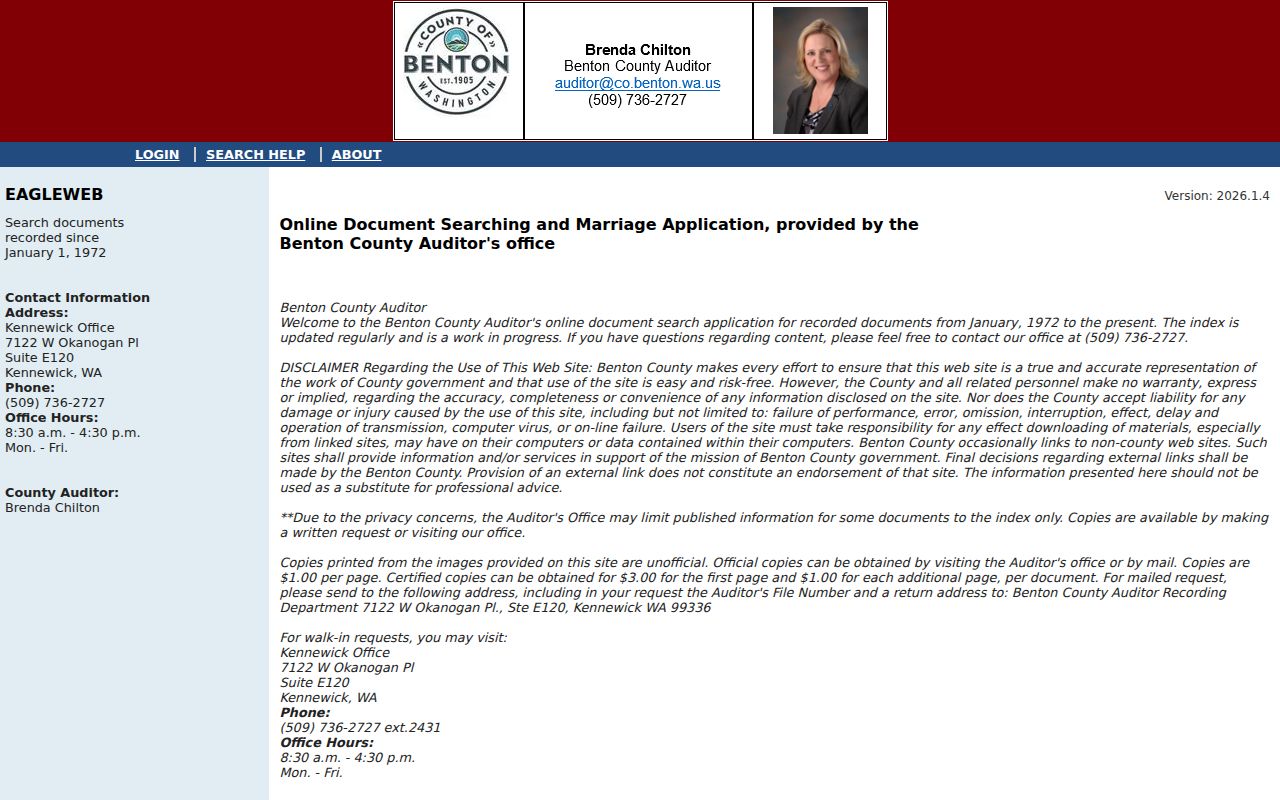
The pictured recorder route is the modern layer; the Archives series was observed with more than 1.3 million records, but its live count and endpoint can change.
Kennewick Past Household Clues
Deeds do not list every past resident. Directories, census schedules, newspapers, obituaries, and archival files can place people near an address at a date. State Library Kennewick runs cover 1911-1918 and selected years from 1952 through 2013, with gaps. The exact holdings appear on the Kennewick city directory page.
- Choose a directory year near the event and search both surname and street section.
- Check adjacent years, initials, and another household member.
- Pair the hit with the parcel and nearby deed dates.
- Search the obituary index or newspaper, saving issue and page details.
No verified online Kennewick criss-cross book or full address-to-person database was found. State Library directories and separate telephone books are the closest documented substitutes. Never fill a missing year by assumption.
Kennewick Resident Permit Clues
City permits can mark building, plumbing, mechanical, sewer, water, and fire-system work. They explain when a structure changed, not who lived inside. Kennewick search routes split around November 1, 2021: older site-plan material uses a legacy search, while current records use EnerGov.
Start at the city public-records search. If no hit appears, file a city request with the address, parcel, permit type, and range. The city distinguishes plot plans, site plans, as-built drawings, and recorded plats. Each answers a different building or boundary question.
| Record | Save |
|---|---|
| Legacy permit | Old result or request response |
| EnerGov permit | Number, type, date, status |
| Recorded plat | AF number and Auditor reference |
Map Previous Kennewick Residents
When a number looks wrong, compare the legal description, plat, AF number, directory year, permit plan, and newspaper notice. No official comprehensive Kennewick renumbering table was located. Keep the mismatch visible rather than attaching previous residents to a guessed lot.
The Library of Congress house-history method combines deeds, directories, maps, photos, permits, and assessments.

The method shows why each address clue should be tested against another record.
Sanborn maps may show a building outline, material, use, street width, lot, or block number. No verified Kennewick edition year surfaced, so ask local repositories rather than inventing one.
Kennewick Resident Obituaries Close Gaps
Mid-Columbia Libraries offers a downloadable obituary list for Tri-City titles from 1905-2020. Search a surname, then locate the article. Save the publication, date, page, and notice type. An obituary may name relatives and former places but can omit parts of a life.
The Kennewick branch at 1620 S. Union Street offers computers, printing, and staff help. Central Washington Archives accepts appointments and written requests for regional material. The East Benton County Historical Society also collects local photographs, oral histories, and files, though its site does not confirm a city-directory or address index.
Note: A newspaper clue grows stronger when its date fits both the directory snapshot and deed chain.
Record Kennewick History Gaps
A missing portal image is not proof of a missing record. EagleWeb says images are unofficial, and privacy rules may leave only index data. Request an official copy from the Benton County Auditor at 7122 W. Okanogan Place, Suite E120, Kennewick, by phone at 509-736-2727, by mail, or at the weekday counter.
Give the date range, grantor, grantee, legal description, and AF number. The observed request form lists an $8 hourly search fee with an $8 minimum, $1 ordinary pages, and certification at $3 for the first page plus $1 for each added page. Confirm current charges before ordering.
For records outside the modern index, ask for the search channel as well as the copy. The Auditor can route a fee number through its historical cash and fee books, while the Washington State Archives Central Region can check cataloged regional holdings by appointment or written request. FamilySearch lists older Benton deed volumes, but viewing rights may depend on the account or research location. Save the repository name, volume, page, and access date even when no image is available. A negative online result then remains a documented gap instead of becoming an unsupported claim that the transfer never occurred.
Directory gaps need the same care. Compare the nearest available Polk years, the Tri-City Herald obituary index, permit dates, and the deed chain, but keep each source in its own dated row. A name found in a newspaper does not by itself prove residence at the parcel. Agreement among an address entry, legal description, and transfer date is far stronger.
Keep one row per source and date: parcel, legal description, directory hit, permit, grantor and grantee, map note, newspaper citation, and doubt. Honest gaps keep the history sound.