
Kennewick Directory Years Preserved
The Washington State Library directory shelf is the most exact inventory for Kennewick. It lists an early Benton Directory run and a much longer sequence filed under Pasco. The broader catalog names change as the area grows from county groupings to Pasco and Kennewick, then Pasco-Kennewick-Richland and Tri-Cities. Those names are more than labels. They tell a researcher which regional volume and city section to open.
| Collection | Years | Where Held | Access |
|---|---|---|---|
| Benton Directory | 1911-1918 | Washington State Library | Cataloged; on-site use |
| Pasco series, including Kennewick | 1952-1957, 1959; 1961-1965; 1967-1974; 1976-1989; 1991-1993; 1995-2008; 2010-2013 | Washington State Library | On-site, appointment-sensitive |
| Regional Polk and Tri-Cities titles | 1910-2025, with missing years | State Library catalog and LibGuide | Confirm each volume |
| Kennewick telephone books | 1958 and 1964 | Washington State Library | Separate collection |
None of these ranges should be read as a promise of one book per year. The State Library LibGuide flags missing years in the Polk and regional title groups. A catalog record can also describe a continuing title without proving that every issue sits on the shelf. Record the title, year, city section, and page for each find. If the desired year is absent, search the edition before and after it instead of filling the gap by guesswork.
Kennewick Across Regional Titles
Early city directory research requires looking beyond a book labeled only Kennewick. R.L. Polk & Co. published county groupings in the 1910s. Later volumes were titled for Pasco and Kennewick, then all three principal Tri-Cities. A surname could therefore be present but filed in a Kennewick subsection of a regional volume. Check the contents and city headings before deciding that a person was omitted.
The title progression also supplies a modest timeline of regional growth. In 1904 Kennewick incorporated, and Benton County followed in 1905. The directory shelf begins with the 1911-1918 county-era run, resumes with Pasco/Kennewick volumes in the 1950s, and expands into Tri-Cities titles that continue through 2025 with gaps. Printed city directories are snapshots, not a continuous register.
Accessing Kennewick Directory Shelves
State Library catalog visibility does not mean a volume is open for walk-in use. Its directory page says these books are on-site materials, and a funding-related notice effective July 1, 2025 describes limited Thursday appointments from 1:00 to 4:00 by email. Confirm current access and the exact volume before traveling. Ask staff to verify the title, year, and Kennewick section.
The Mid-Columbia Libraries Kennewick branch, at 1620 S. Union Street, is a practical local work base. Its listed hours are Sunday 10 to 6, Monday through Thursday 9 to 8, and Friday and Saturday 10 to 6. Computers, Wi-Fi, printers, study rooms, and five free printed pages each day support follow-up research, but the official branch page does not confirm that it holds the State Library directory run.
The State Library access page shows the current appointment constraints directly. Review the State Library's directory access notice before planning a visit.
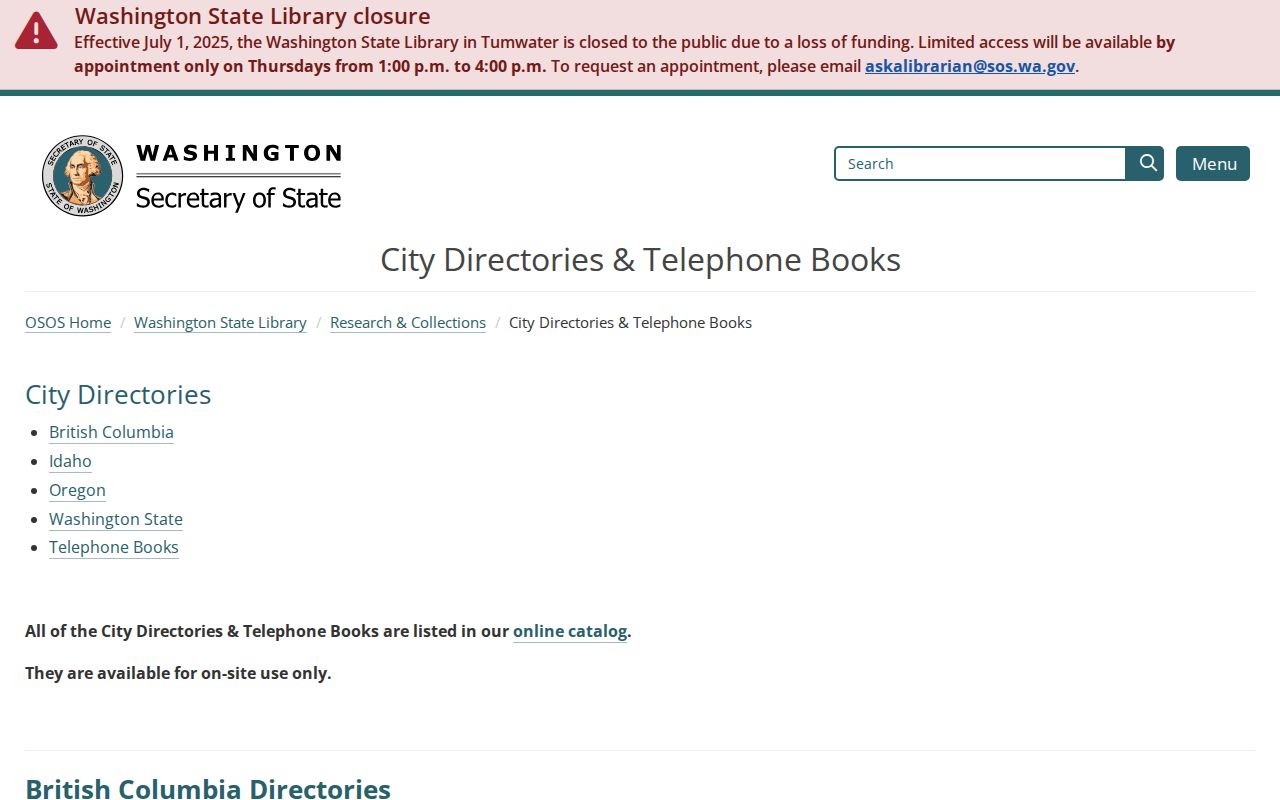
The captured page is the source for the Kennewick runs and the distinction between directories and telephone books.
Reading Kennewick Directory Entries
Start in the correct year and Kennewick city section, then copy the entry exactly as printed. A city directory may shorten given names, occupations, firms, and streets. The abbreviation key controls what those marks mean in that edition. A directory was often built from canvassing or subscriptions, so the printed facts can lag a move and should not be treated as a current address.
| Name | Surname and given name or initials; a spouse may appear in parentheses. |
|---|---|
| Printed work detail | Occupation, business, or firm wording as the publisher recorded it. |
| Address | House number and street at the time the volume was compiled. |
| Household marks | Symbols or short forms may distinguish household roles or residence notes. |
| Source reference | Volume title, year, city section, and page needed to find the entry again. |
- Criss-cross directory
- A later directory arranged by street and house number instead of surname.
- Householder index
- A list centered on the named person associated with a household, not every occupant.
- Abbreviation key
- The publisher's guide to the short forms used for names, streets, work, and household notes.
Photograph or transcribe the key along with the entry. Without it, one letter can be misread as an owner mark, a rooming note, or part of a street name. Then check the address in the street-order section if the volume has one. That second view can reveal nearby households and help resolve two residents who share a surname.
Kennewick Obituary Index Cross-Checks
A directory name becomes more useful when paired with a dated newspaper lead. The Tri-City Herald obituaries index is a downloadable spreadsheet covering notices from 1905 through 2020 in the Tri-City Herald, Kennewick Courier Reporter, and Pasco Herald Express. Search the surname, note the title and date, then locate the underlying notice through library or newspaper channels.
An index row is not the article, and an obituary is not a certified death record. Preserve the paper, date, page or issue identifier, and type of notice. The Washington Secretary of State genealogy resources also describe newspaper microfilm from 1853 onward and an interlibrary-loan path for as many as ten rolls for four weeks. Local periodicals include the East Benton County Historical Society Courier and Tri-City Genealogical Society Bulletin.
Note: A directory address and obituary relationship should be recorded as two dated sources, not merged into one unsupported life story.
Kennewick Clues in State Archives
The Washington State Archives collections search extends a city directory find into county records. Its Benton series includes land records from 1969 to the present, marriage records from 1987 to the present, and a naturalization index from 1905 through 1954. At the observed crawl, those collections reported 1,348,554 land records, 74,405 marriage records, and 2,555 naturalization records. Counts can change as records are added.
Non-digital holdings can require a guide, written request, or repository visit. The Central Region branch at Central Washington University in Ellensburg lists Wednesday through Friday research by appointment, with phone or email access on Monday and Tuesday. Viewing public archival documents carries no request fee, though copies and staff research may cost money. FamilySearch's Benton land catalog also describes digitized land volumes from 1871 to 1985, but image access can require an account or a FamilySearch Center.
Local History Beyond City Directories
The East Benton County Historical Society and Museum at 205 W. Keewaydin Drive preserves material about the people and history of Kennewick, Richland, Finley, Hover, Hanford, and White Bluffs. Its stated mission supports questions about photographs, oral histories, vertical files, and local publications. The official site does not confirm a city directory or criss-cross collection, so contact staff before assuming a named book is held there.
Kennewick's city history places the discovery of Kennewick Man at Columbia Park during hydroplane races and dates the remains at about 9,200 years. That story is not a resident entry, but it shows why local history must be kept distinct from directory evidence. Use museum context to understand place and community, while retaining the printed volume as the source for a named household.
Trace Families Through Kennewick Directories
A reliable family timeline moves one dated step at a time. Begin with the strongest known surname and year, then test initials and household members. Move across adjacent editions to find arrivals, departures, and address changes. Census records can test a directory snapshot at decade intervals, while deeds and newspapers can explain what happened between those points.
- Find the first likely surname entry in a verified Kennewick volume and save the full citation.
- Search the same name, initials, spouse, and address in the editions immediately before and after it.
- Use the street-order or criss-cross section, when present, to test the house number and nearby names.
- Compare the directory dates with census years and the Benton deed or naturalization indexes.
- Close the trail with the local obituary spreadsheet, newspaper issue, or an eligible vital-record product.
Disappearance alone proves little. The resident may have moved, died, been omitted, used a different form of the name, or appeared in another city section. Search at least one neighboring year on both sides. For a modern address-based search, use the Kennewick street directory rather than treating an old printed address as current.
Document Each Kennewick Directory Find
Keep a source log for every city directory entry. Record the exact title, publisher if shown, year, city section, page, surname spelling, street line, and abbreviations. Add a note describing whether the item was a directory, telephone book, catalog record, index, or original image. These are different forms of evidence.
A catalog description confirms that a title exists. It does not confirm the person appears in it. A spreadsheet row points toward a newspaper notice but does not replace the notice. A deed index points to a recorded instrument but may not show the full image. Clear labels prevent a family timeline from growing more certain than its sources allow.
Also preserve the search that failed. Note the surname forms, initials, years, and city sections checked. A negative log keeps the same volume from being searched twice and makes the next step clear. It may point toward a missing edition, a regional title filed under Pasco, a telephone book rather than a Polk directory, or a move that should be tested in deeds and newspapers.